The Secret to Crispy Menus: How to Choose the Right French Fry Box?
For fast-food chains, burger shops, and boutique snack bars, the quality of takeaway operations is measured by whether the food can retain the freshness it had when it left the kitchen all the way to the moment of delivery. When the wrong French fry box is chosen for the most dynamic yet most exterior-sensitive item on the menu—French fries—problems like sogginess and softening become inevitable. Building professional packaging that withstands the heavy water vapor caused by high temperature, the tendency of frying oil to leak, and the jostling during transport directly determines your business’s loyal customer rate. In this guide, we examine the design standards that prevent fries from losing their crispness during takeaway service and the key criteria to pay attention to in corporate purchasing processes.
When planning the right disposable French fry box solutions for cafés and quick-service locations, both the heat-retaining cardboard structure and the innovative details that vent moisture out need to be evaluated together. Choosing the right packaging ensures fries reach the consumer with their first-minute crispness and flavor intact, preventing delivery related customer complaints.
How Can Fries Be Kept Crispy During Takeaway Service?
Keeping fried products crispy during takeaway logistics is entirely a moisture-management process related to packaging engineering. Fries coming out of the fryer at approximately 170°C to 180°C begin rapidly releasing heat and evaporating once placed in the packaging. In standard, closed, non-ventilated boxes, this steam hits the inner surface of the cardboard and turns into water droplets. The moisture that drips back onto the fries softens the crispy outer layer, making the product soggy.
To solve this operational problem and keep fries crispy during takeaway service, designs that don’t block airflow should be used. Open-top conical structures used in advanced food packaging designs, or the strategic steam holes found in lidded models, retain hot air inside while releasing excess moisture outside. This way, fries are prevented from turning doughy even during the 20-30 minute transport time spent in a courier bag.
| Packaging Type | Moisture Venting Capability | Heat Retention Performance | Ideal Use Area |
| Ventilated Lidded Box | High (Special Perforated System) | Strong (Enclosed Compartment) | Long-distance takeaway deliveries |
| Open-Top Conical Box | Maximum (Natural Venting) | Medium (Open Surface) | Take-away and quick consumption |
| Grooved Scoop Model | High (Wide Opening Structure) | Medium (Quick Consumption) | In-menu side dish presentations |
Criteria to ConsiderWhen Choosing a Cardboard French Fry Box
When planning packaging procurement for your business, focusing only on the shape or price of the box can lead to operational losses in the long run. When choosing a quality cardboard French fry box, the quality of the raw material, the weight of the paper, and the inner surface coating must be evaluated as a whole. Two main raw material groups stand out as being heavily preferred in the sector:
Kraft French fry box: Unbleached kraft papers made from natural cellulose fibers offer the customer a “natural” and “additive-free” product perception with their brown texture. They have high heat insulation strength.
White cardboard fry box: Provides the smoothest surface, best suited for printing multi-colored corporate graphics and high-resolution logos.
The most critical technical parameter at the selection stage is whether the base of the box meets the grease-proof fry packaging standard. If the vegetable oils on the fries are absorbed by the cardboard fibers, unsightly stains form on the outer surface of the packaging and the box softens, losing its upright stance. The food-safe barrier coatings used on the inner surface prevent oil from leaking out, guaranteeing a hygienic and clean presentation.
Speed in Restaurant Operations: Self-Locking Base Designs
Especially during evening hours, when orders pile up, the kitchen staff’s greatest need is practical packaging forms. Packaging that folds in multiple pieces and takes a long time to assemble slows down service speed and causes logistical delays. In the food packaging industry, this is calculated as “operational labor cost.”
The self-locking systems applied in new-generation wholesale French fry box designs allow the box to be assembled in seconds with a single hand motion. Staff simply press on the sides of the box to lock the base tabs together, and the packaging is ready to be filled. These boxes, which are stored completely disassembled in the storage area, save space in the kitchen while minimizing order preparation times even during the busiest hours.
Click here for all Food Box Products.
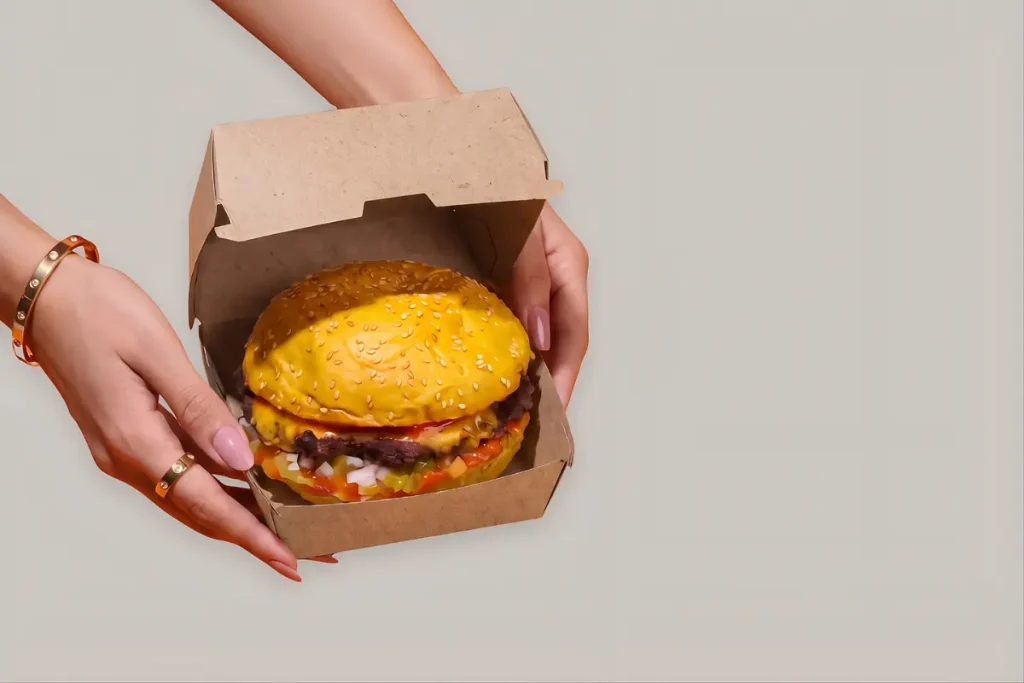
Team Packaging in Fast-Food Menus: French Fry and Burger Box Coordination
Consumer research shows that brands achieving visual consistency in packaging have a higher perceived corporate reliability compared to those using mismatched packaging. When a customer ordering from a restaurant sees different color tones, different paper qualities, or mismatched logos between the burger box and the printed fry box models, it creates an inconsistent brand image.
To benefit from the positive impact of consistent packaging on brand recognition, the menu needs to be designed as a “team.” It is critically important for all components—from the fry box to the burger box, from the takeaway bag to the paper cup—to come off the production line of the same packaging manufacturer. Products printed at the same factory don’t experience color deviations. This way, the packaging creates unity in the kitchen while also becoming an indicator of corporate standards at the customer’s door. Using shared raw materials and structuring bulk orders creates economies of scale on printed fry box prices, also lowering your business’s total packaging cost.
Ideal Disposable French Fry Box Models Based on Portion Standards
The fundamental way to maintain profitability balance in restaurants is portion standardization. To be able to offer the customer the same amount of product with every order, box sizes suited to the weight classes on your menu need to be determined. Incorrect size selection either leads the customer to find the portion too small, or leads to cost waste from adding extra product to fill the box.
The comparison table below shows the most commonly used fry packaging forms and portion matches in fast-food operations:
| Product Model/Form | Ideal PortionWeight | Standout Technical Feature | Most Suitable Menu Item |
| Scoop/Conical Model | 80 g – 110 g (Small/Medium) | Open-top structure, quick filling | Standard menu fries |
| Lidded Locking Box | 120 g – 160 g (Large) | Ventilated lid, high heat retention | Long-distance gourmet burger takeaway |
| Wide Packaging Tray | 200 g and above (Shareable) | Low body, wide horizontal surface | Crispy snacks with sauce and melted cheese |
| Cardboard Fry Cone | 100 g – 130 g (With Sauce Compartment) | Built-in sauce pocket, take-away friendly | Dip-sauce street foods |
In food packaging procurement processes, the technical guidelines of international independent organizations clearly define the resistance standards of cardboard materials against food acids and high-temperature vegetable oils. In light of this technical data, achieving the right combination of weight and form reduces operational risks to zero.
Frequently Asked Questions (FAQ)
How can fries be prevented from going soggy and soft during takeaway service?
To prevent fries from softening, the water vapor that accumulates inside the box due to heat needs to be vented out. For this, cardboard packaging with steam vent holes on the top surface or side walls should be preferred, and liquid sauces should not be poured directly onto the fries during delivery but served in separate containers.
Can a cardboard fry box go in the microwave?
Standard cardboard packaging with a polyethylene (PE) protective barrier or grease-resistant industrial layer on the inner surface is not recommended for exposure to high wavelength and direct heat in a microwave oven. If microwave heating is planned, food containers with special polymer structures suited to this process or an oven-safe raw material certification should be preferred instead.
What determines the ideal French fry box dimensions for restaurants?
The ideal packaging size is determined based on the portion weight your menu commits to (for example, 90 grams for small, 150 grams for large). The interior volume of the packaging should be wide enough not to compress the fries, but should also not leave excessively large empty spaces that cause the product to shift around inside the courier bag.
How long do ventilated fry boxes preserve crispness?
Ventilated professional boxes safely preserve the crispness of properly fryer-drained fries for an average of 20 to 30 minutes inside a takeaway courier bag. This duration can vary depending on the outdoor temperature and the insulation quality of the takeaway bag.
Should a lidded fry box or an open-top scoop model be preferred?
For takeaway operations sent over long distances, lidded French fry box models should be preferred to prevent heat loss in the product. For in-restaurant self-service counters, mall food courts, or instant take-away concepts, open-top scoop models, which offer filling speed and practicality, are more functional.

