The growing popularity of healthy eating and grab-and-go consumption has significantly increased the share of fresh greens and rich salad bowls on restaurant delivery menus. However, getting these delicate menu items to the customer in the same fresh condition they left the kitchen depends entirely on the technical qualities of the salad container packaging used. The wrong packaging choice leads to oil and dressing leaks, wilted lettuce, or lids popping open – all of which directly lower a business’s customer satisfaction scores. In this guide, we cover the packaging standards that fully preserve product presentation during delivery and the key selection criteria for choosing the right container for your business.
For cafes and delivery-focused outlets, choosing the right disposable salad container means weighing both moisture-resistant barrier coatings that withstand dressing condensation and body strength that won’t collapse when containers are stacked. The right packaging setup keeps greens looking fresh and vibrant all the way to the end consumer, protecting your brand’s quality reputation at every step of delivery.
How to Keep Salad Fresh and Intact During Delivery
Preserving a salad’s freshness and structural integrity during delivery comes down to controlling internal moisture with non-condensing lid systems and adding dressing as close to service time as possible. Temperature swings or moisture released by the lettuce itself can soften the interior surface of low-quality salad containers, causing the base to collapse.
To prevent this, look for packaging with a polyethylene (PE) protective barrier on the interior and a leak-proof lid seat – this reduces operational risk to near zero.
Leak-Proof Criteria When Choosing a Lidded Paper Salad Bowl
The most common cause of leaking is liquid dressings – olive oil, lemon juice, pomegranate molasses – escaping through gaps between the rim of the bowl and the lid. Many restaurant managers report that lidded salad containers leak at the edges once they’re jostled inside a courier delivery bag.
In industrial production, the leak resistance of a lidded paper salad bowl depends on how smoothly the curled rim of the paper bowl is pressed during manufacturing. If the lid’s inner tabs don’t seat onto the bowl’s rim with millimeter-level precision, liquid dressing will leak out under movement and vibration.
For secure delivery, paperboard bowls with a high-quality interior PE barrier coating should be paired with clear, vented lids that are precision-molded to match the bowl body exactly.
How to Choose a Food-Safe Salad Container
Protecting food hygiene and consumer health starts with making sure packaging is manufactured in facilities that meet international food safety standards. Generic disposable salad containers can carry a risk of chemical migration, which can directly damage your business’s reputation.
When choosing food-safe packaging, check whether the manufacturing facility holds certifications that document compliance with recognized global standards. Properly made packaging won’t develop odors when in contact with hot or acidic sauces, and paper fibers won’t leach into the food. Ensuring this level of safety means working with vertically integrated manufacturers that control the entire production chain from raw material to finished product, rather than going through intermediary suppliers.
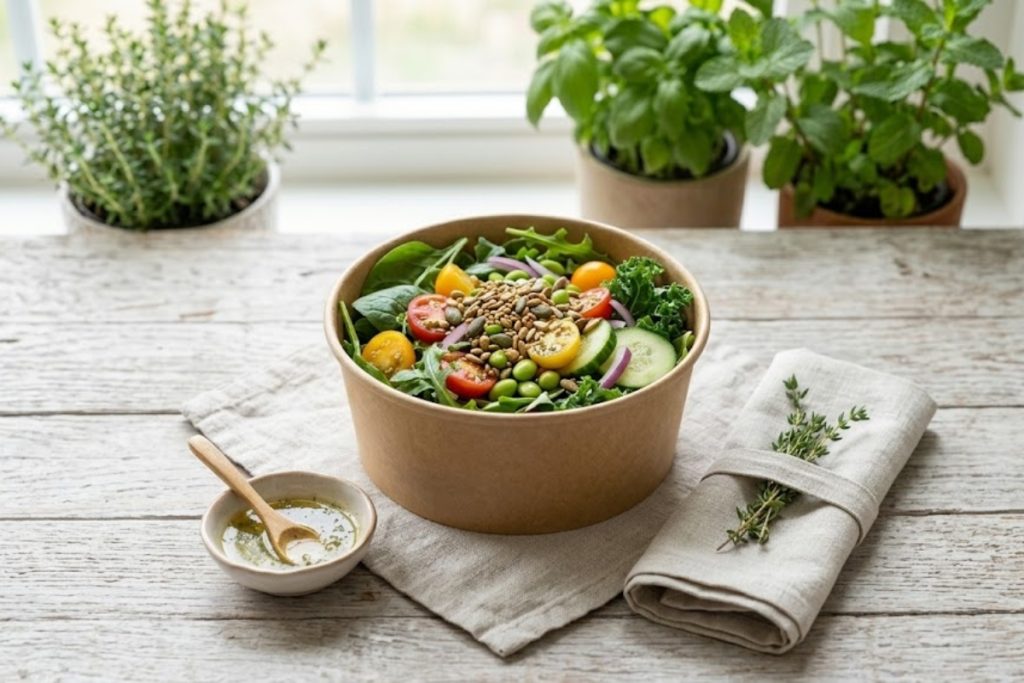
Paper Salad Bowl Sizes: Choosing the Right CC Capacity for Your Menu
To maintain accurate portion sizes and consistent weight standards across your salad menu, you need to choose the right volume for your business. For restaurant chains aiming for operational consistency, paper salad bowl sizes and their cc-based volume options form the foundation of any purchasing list.
550cc Salad Container
550cc containers are typically chosen for small side salads, appetizers, and starter portions on diet-focused menus. Their compact size works especially well in fast-service buffet sections, helping balance cost while minimizing portion waste.
750cc Salad Container
For standard cafe menu items like chicken, Caesar, or tuna salads, a 750cc paper salad bowl offers the most balanced portioning. This size gives enough room to toss dressing through the greens properly, making it the most functional choice for mid-size delivery orders.
1000cc Salad Container
For hearty, main-course salads loaded with grains and mixed ingredients, a 1000cc container is the right choice. Its larger volume prevents ingredients from getting crushed together and allows dressing to distribute evenly throughout, improving the overall eating experience.
1300cc Salad Container
For catering companies, large events, or family-style shareable salad menus, a 1300cc container offers the most generous capacity. This higher-volume solution ensures ingredients stay fresh, uncrushed, and intact during transport.
Best Salad Container Options for Restaurants
Operational efficiency and presentation quality for restaurants are directly tied to choosing the right packaging format for each menu item.
The comparison table below shows which container type best fits each type of menu item for your delivery operations:
Product Category | Ideal Volume (CC) | Lid Type & Feature | Key Advantage | Best Suited For |
Paper Salad Bowl | 750cc / 1000cc | Clear Anti-Fog PET Lid | Visible contents, no fogging | Chicken, Caesar, grain-based main salads |
Paper Soup Container | 400cc / 500cc | Vented PP Lid | High heat resistance, zero spill risk | Hot soups, stews, sauces |
Paper Ice Cream Container | 150cc / 250cc | Double-Wall Body / Paper Lid | Freeze resistance, condensation control | Gelato, frozen fruit purees |
Kraft Takeout Boxes | Various Sizes | Integrated Locking Lid | Maintains crispiness, ventilation channels | Fries, burgers, fried foods |
Frequently Asked Questions (FAQ)
How do you prevent salad from getting soggy or wilted during delivery?
To prevent sogginess, liquid dressings like lemon juice, olive oil, or pomegranate molasses shouldn’t be poured directly into the container, they should be served separately in small side cups. Additionally, micro-ventilation holes in the lid help reduce internal moisture buildup, which slows down wilting.
What’s the ideal salad container size for restaurants, in cc?
For main-course salad service, the most commonly chosen sizes are 750cc and 1000cc containers. For side dishes or smaller diet-focused starter portions, 550cc containers offer a more flexible option.
Do paper salad containers leak dressing?
Paper containers manufactured with a food-safe interior polyethylene (PE) barrier coating do not leak even oily, acidic dressings. Leaks are usually not caused by the bowl body itself, but by a mismatch between the lid’s seal and the precise diameter of the bowl’s rim.
Do clear PET lids fit paper bowls properly?
Yes, when both packaging components are manufactured in the same integrated facility using matching mold standards, clear PET lids lock onto the bowl’s rim with millimeter precision. To eliminate mismatch and leak risk, it’s best to source the bowl and lid as a matched set from the same manufacturer.

